If the your doctor, observing trials as they are made his debut with this typical sentence: "you have too high cholesterol, we have to change the diet "..... well .... it's time to change doctors.

It sounds crazy and I support that view when many believe it really, but this provocation wants to focus on the superficiality of some specialists in dealing with a very complex subject as the cholesterol . Not a day passes without some advertising there this prospectus or that food can lower the level. To date, the hypothesis is clearly established, except in rare flies white, according to which cholesterol is closely related, if not solely responsible, of atherosclerosis. But have we ever stopped to think about what cholesterol is and if it really is so harmful to human health?.
As usual our first explain what is cholesterol and what functions are performed by the body, trying to treat the subject as understandable as possible, and then dissect them g aspects of the possible correlation with cardiovascular disease.
Cholesterol is a lipid molecule whose structure consists of four rings policicloalifatici (very simply means that the double bonds are fixed within the different rings) linked together by carbon atoms and an aliphatic tail. We can see structural formula in the picture below.
E 'produced largely by the liver, although involved in its synthesis of other organs such as adrenals, testes, etc.. Then enters the bloodstream and "colonize" the various organs of the body. In the brain, the concentration is high and this organ is able to produce it by itself, since the molecule cholesterol could not pass the blood-brain barrier.
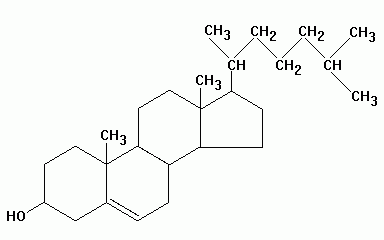
colestrolo The place inside the human body functions of fundamental importance: it is a steroid and take it home, through biochemical processes, all steroid hormones (testosterone, progesterone, estradiol, etc.). actively participates in the stabilization of cell interposed between the lipids of the cell walls of neighboring cells; is responsible for embryonic development and is the precursor of vitamin D and bile.
Let's see, now, because despite all the positive aspects listed above, the majority of doctors and specialists in movement is cholesterol as if the evil of the century. The reason is very simple, but first you need to make an introduction.
cholesterol, as we saw, once a product is released into the bloodstream to reach the various parts of the body. In the circle blood it is not free, but is tied to particular proteins, forming together with these so-called lipoproteins. These have different densities for which we will, if low-density lipoprotein cholesterol LDL (low density lipoproteins) in the case instead of lipoprotein density of HDL cholesterol (high density lipoproteins).
Now tell me what's the problem. The problem, unfortunately, is all the difference in density that gives the number of molecules cholesterol behavior, so to speak, antithetical.
There is a theory, enough credits in science, according to which the endothelial cells that lines the blood vessels possess the special structures, called caveolae, which possess a receptor (CD36 ) for LDL cholesterol. These receptors bind to molecules of LDL cholesterol and passage through caveolae are transported from the opposite side of the endothelial cell, accumulating and causing, therefore, the narrowing of the lumen of blood vessels. Quite simply what we call atherosclerosis, which, as explained in the post on stroke of 04/10/10 to invite you to read, seems to be the foundation of cardiovascular disease. HDL cholesterol, in contrast, plays an opposite, by binding to molecules of LDL cholesterol, and reported that the production site, the liver.
This, perspective, now is the situation regarding cholesterol. This molecule, incorrectly or rightly, we shall see later to try to shed light on this aspect is singled out as one of the main risk factors for cardiovascular disease. We wish now, however, exhibit a series of arguments based on logical reasoning and without obvious bias, that run counter to what has been said and aimed to provide a different perspective than the common doctrine:
- makes no sense to speak of cholesterol in general, as we have seen, is divided into two forms with opposite functions. Shun doctors who prescribe the total cholesterol in the analysis and the determination of LDL and HDL, is a fact that, alone, is useless.
- There is good cholesterol and bad. Cholesterol, as we have seen plays important functions in the body. We could discuss the possible harm of an excess in the blood. Today, worldwide, are proposed tables where it is recommended that the total cholesterol level should not exceed 200 mg / dL. Never mind that we have seen the futility of this, I would like to make you think about a theory that we are trying to develop for some time: we have seen that cholesterol serve in particular to the synthesis of steroid hormones and other substances, we know also that the level of these hormones is extremely variable from individual to individual, so it follows, by applying a very simple reason, that the level of cholesterol in the blood " must "be different for different individuals. Our thought is that the cholesterol level is established at the genetic level, so each of us, from birth, has predetermined by their genes, the level of colestrolo necessary for the functions of your body, that level will therefore be different for each of us. Try to vary considerably from the pre-set range will not be easy nor recommended. It seems clear, therefore, that provide valid erga omnes of the numbers does not make sense, but rather, the focus should be to determine what your cholesterol threshold above which creates the risk of atherosclerosis.
- A suffrage of this argument, as an example the scientific evidence that the cholesterol level is influenced by dietary cholesterol (exogenous) to only a small part, while most cholesterol produced by the body to its needs, it is of endogenous origin. Reduce cholesterol in the diet, therefore, does not more than to increase the synthesis in the liver. Therefore, drastic diets aimed at reducing, if not the elimination of cholesterol, are doomed to failure. We can take for example the case of certain patients with hypercholesterolemia who, while introducing a diet free of fats, found no change in the parameters of their cholesterol, in this case, the liver to compensate for loss of income of it, by producing larger quantities.
- If cholesterol is a physiological substance useful as it can become suddenly in a harmful substance?
- How do you explain the occurrence of stroke in patients with cholesterol 160 mg. / dl.? And, conversely, the absence of stroke in those patients, so-called at risk, with cholesterol greater than 300 mg. / dl.?
conclude, hoping that people do not rely on a number they felt sick or healthy. Establish a number, representing present a sort of a Pillars of Hercules not to be exceeded only serves the pharmaceutical companies to create new "fake sick". In a few years the threshold of 200 mg. / dl. will be further lowered overnight and were previously healthy people who will suddenly ill, with the consequence of having to go through laboratory investigations, medical care, etc.. and the wheel will keep turning, enriching unscrupulous people. Therefore attention goes to our health and our portfolio.


0 comments:
Post a Comment